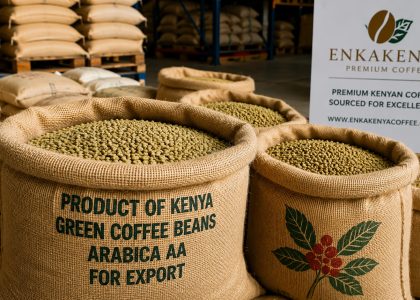


For businesses exploring the Kenyan Arabica coffee Oman market, the opportunity is about more than adding another green coffee origin. Oman’s coffee sector continues to develop across cafés, roasters, hospitality and retail, creating opportunities for businesses that can offer distinctive coffee experiences. Fresh-ground coffee has also been gaining attention in Oman, making origin and product differentiation increasingly relevant to coffee businesses.
For importers, distributors, cafés and roasters, Kenyan Arabica can provide another origin for a differentiated portfolio. Rather than competing only on price, Kenyan Arabica green coffee can be evaluated for its origin character, specialty applications and potential to create distinctive products for Omani customers.
Why Kenyan Arabica Is Relevant to Oman
Kenyan coffee has an established reputation as an Arabica origin with coffees that can display bright acidity, fruit character, sweetness and a clean, expressive cup. The actual profile varies by coffee, growing environment, variety, processing and post-harvest handling, so buyers should evaluate individual lots rather than assume that every Kenyan coffee will taste the same.
This variation is useful for an Omani roaster. It creates opportunities to test different coffees for filter, espresso, single-origin and blending programmes and to develop products for different customer preferences.
Kenya’s coffee sector is also supported by dedicated research. The Kenya Coffee Research Institute, operating under the Kenya Agricultural and Livestock Research Organization, provides research and development support across the coffee value chain.
How Kenyan Arabica Can Add Differentiation
For an Omani coffee business, differentiation can be more valuable than simply adding another commodity product to the catalogue.
A roaster may already work with several origins. Kenyan Arabica can complement those coffees rather than replace them. One origin might contribute body and sweetness to an espresso blend, while another provides chocolate or nutty characteristics. A carefully selected Kenyan coffee can add brightness, fruit character or a distinctive single-origin option.
This portfolio approach allows a business to create different products for different customers without depending on one coffee for every application.
Single-Origin Kenyan Coffee for Omani Cafés
Single-origin coffee can be particularly useful for cafés and specialty roasters that want customers to understand more about the coffee they are drinking.
Instead of listing a product simply as Arabica, a café can communicate its country of origin, available regional information, processing method, roast approach and expected sensory characteristics. This gives baristas a stronger story to share with customers and creates a more specific product proposition.
Businesses interested in developing a single-origin programme can also explore EnkaKenya’s single-origin Kenyan coffee resources for additional context.
The International Trade Centre’s Coffee Guide also provides a useful overview of the international coffee value chain, from production and trade through roasting and consumption.
Where Kenyan Coffee Can Fit in an Oman Coffee Portfolio
There is no single application for Kenyan coffee. Its suitability should be determined through sample evaluation and roasting trials.
- Single-origin filter coffee
- Premium espresso
- Seasonal specialty releases
- Espresso blends
- Wholesale roasted coffee programmes
- Private-label coffee
- Premium hospitality and food-service programmes
For cafés, a suitable Kenyan lot can become a rotating feature. For roasters, it can form part of a specialty range or blend. For distributors, it can add a recognizable African origin to an existing portfolio.
Roasting Kenyan Arabica for the Intended Market
The roasting approach should be based on the characteristics of the individual coffee rather than simply on its country of origin.
Different coffees can respond differently to heat application, development time and brewing method. A professional roaster should therefore begin with sample roasting and compare results before selecting a production profile.
EnkaKenya’s existing guidance on choosing the right roast profile for your market can help buyers think about how roast development should align with customer preferences and brewing applications.
The objective is not simply to make the coffee lighter or darker. It is to develop a balanced cup that works for the intended customer, brewing method and product position.
Why Sample Evaluation Matters
Businesses considering Kenyan coffee should evaluate samples before committing to significant commercial volumes.
A practical evaluation can include:
- Green-bean appearance
- Aroma
- Available moisture information
- Roasting performance
- Acidity
- Sweetness
- Body
- Balance
- Aftertaste
- Brewing performance
The sample should be assessed according to the intended application. A coffee being considered for filter brewing may be evaluated differently from a coffee intended for an espresso blend.
Sampling also gives an importer a better basis for comparing suppliers. Instead of choosing entirely on a catalogue description or quoted price, the buyer can evaluate actual product performance.
What Oman Coffee Import Data Shows
Oman’s green coffee market provides a useful commercial context for businesses considering another origin. World Bank WITS data records approximately 7.67 million kg of unroasted, non-decaffeinated coffee imports into Oman in 2024, valued at about US$35.12 million. Kenya supplied approximately 14,616 kg worth about US$70,060 in that category. The Oman green coffee import data provides a useful baseline for understanding the existing trade.
Kenya’s recorded share was relatively small compared with several major suppliers. This does not guarantee future growth, but it confirms that Kenyan coffee already enters the Omani market while leaving room for stronger commercial relationships between Kenyan exporters and Omani buyers.
For an importer, this creates an opportunity to test Kenyan coffee as an additional origin and assess whether it fits a particular customer segment.
Origin, Transparency and the Premium Coffee Proposition
Specialty coffee buyers increasingly consider information beyond the beverage itself. Origin, processing, producer information and sourcing practices can contribute to the story and value proposition of a coffee when the information is accurate and properly documented.
This can be especially useful for cafés and roasters selling premium coffee directly to consumers. A business can explain where the coffee comes from, how it was processed and why the particular lot was selected.
EnkaKenya’s Kenyan coffee sourcing and traceability approach focuses on direct relationships with smallholder farmers, traceability and export-ready Arabica for international buyers.
For an Omani buyer, transparent sourcing information can help support a more credible premium coffee proposition.
Why Kenyan Arabica Can Work for Specialty Coffee Oman Businesses
The potential value of Kenyan Arabica in the Oman market comes from its ability to support different commercial formats.
- A specialty café can feature a Kenyan single origin.
- A roaster can develop a dedicated Kenyan offering.
- A distributor can add an African origin to its portfolio.
- A hospitality business can introduce a premium coffee option.
- A private-label company can develop a differentiated product around Kenyan origin.
However, premium positioning should always be supported by the actual quality and consistency of the coffee. A country name alone does not guarantee that every lot will meet a particular roaster’s requirements.
Questions Omani Buyers Should Ask a Kenyan Coffee Supplier
Before purchasing, an importer or roaster can ask:
- Where was the coffee produced?
- What processing method was used?
- What sensory characteristics are expected?
- Can a representative sample be supplied?
- What quality information accompanies the lot?
- What volumes are available?
- What packaging is used?
- What export documentation is provided?
- What are the expected lead times?
- Can the supplier support repeat purchasing?
These questions turn a simple price enquiry into a more useful sourcing conversation.
Kenyan Arabica as a Strategic Addition to Oman’s Coffee Market
The opportunity for Kenyan Arabica coffee Oman buyers is best understood as a portfolio decision. An importer can use it to add another origin, a roaster can develop a differentiated single-origin or blend component, and a café can introduce a seasonal specialty option.
The right approach is to define the intended application, request representative samples, evaluate the coffee and then determine whether the product makes commercial sense at the required volume and price.
Businesses wanting to understand EnkaKenya’s wider export offering can explore the company’s Kenyan coffee export articles for additional sourcing and market information.
Conclusion
Kenyan Arabica coffee Oman buyers can consider is more than another green coffee option. It can give importers, roasters and cafés an opportunity to introduce a recognizable African origin with distinctive sensory potential and a strong basis for product differentiation.
Oman’s developing coffee culture creates an environment in which businesses can explore new origins and product concepts. The most effective approach, however, is disciplined sourcing: evaluate samples, verify quality information, understand the intended roasting application and select suppliers based on the complete commercial proposition.
EnkaKenya Premium Coffee supplies export-ready Kenyan Arabica for international buyers. Explore the EnkaKenya coffee portfolio or contact the EnkaKenya team to discuss samples, volumes and sourcing requirements.
Frequently Asked Questions
Why should Omani roasters consider Kenyan Arabica?
Kenyan Arabica can offer distinctive acidity, fruit character, sweetness and origin identity, making it worth evaluating for specialty, single-origin and blend applications.
Can Kenyan coffee be used in espresso?
Yes. Individual Kenyan coffees can be tested for espresso and blend applications. Suitability depends on the specific coffee and the roast profile developed by the roaster.
Is Kenyan coffee already imported into Oman?
Yes. World Bank WITS data records Kenyan green coffee entering Oman. In 2024, Kenya supplied approximately 14,616 kg of unroasted, non-decaffeinated coffee to Oman.
Should I buy Kenyan coffee based only on its reputation?
No. Buyers should evaluate the specific lot, sample the coffee, review available quality information and determine whether it fits the intended market and roasting programme.
Can Kenyan Arabica be used for a single-origin coffee?
Yes. A suitable Kenyan lot can be developed as a single-origin offering when its sensory characteristics, consistency and commercial availability fit the roaster’s programme.